

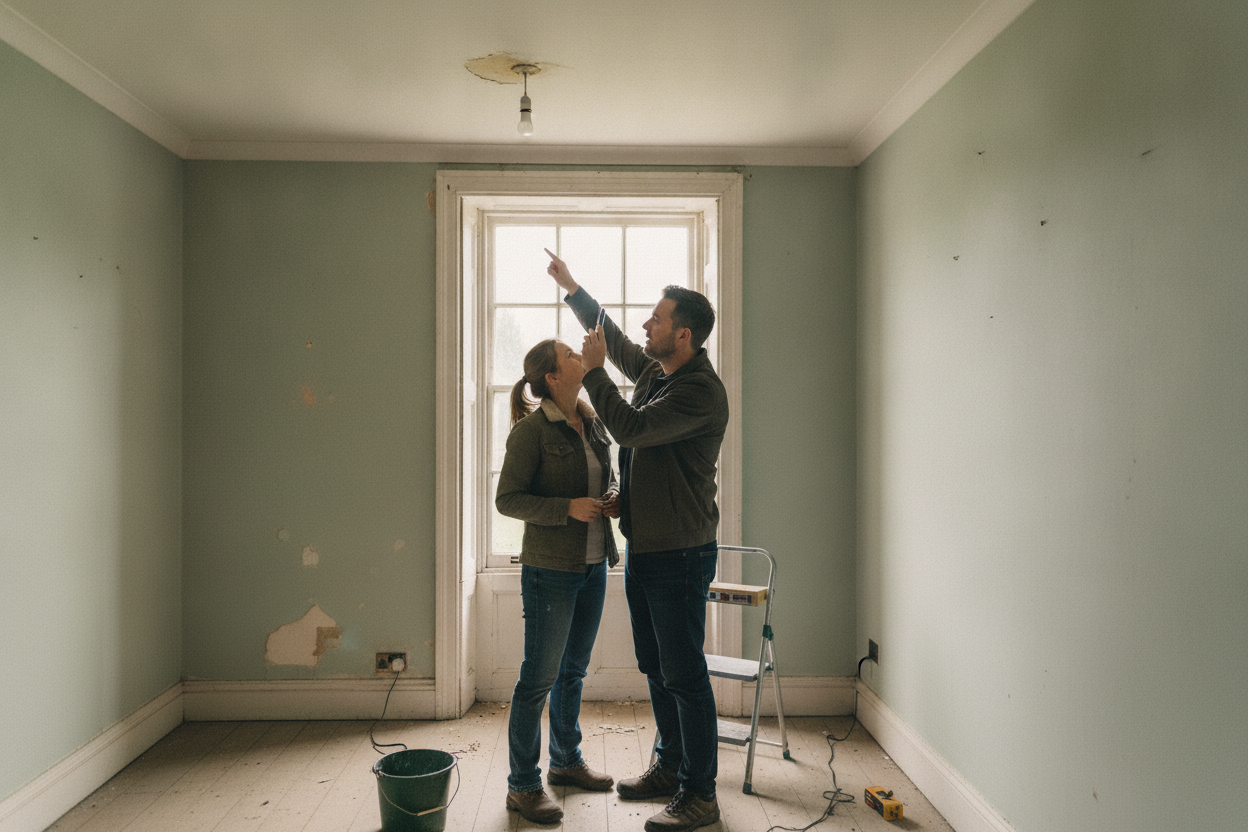
Most renovations that run badly over time and budget were not derailed by the work itself. They were derailed by something that was already there before anyone picked up a tool, and nobody looked for it.
The instinct to just get started is understandable. You have waited months for the money, the trades and the free weekends to line up, so pulling up the old floor feels like progress. But ten minutes with a torch and your phone camera, before a single fixing comes out, is the cheapest survey you will ever do.
None of what follows requires a qualification. It is a home inspection checklist you can run yourself, in the time it takes the kettle to boil twice, and it tends to catch the things that turn a three-week job into a seven-week one.
Start With Checking the Damp Spots
Damp is the issue that most often rewrites a schedule, because you cannot plaster, tile or fit anything over it and expect it to last. Look along the bottom 30cm of external walls for tide marks, blown or crumbling plaster, and a white salty bloom. Then look at the top corners of rooms and behind furniture for the black speckling of condensation mould.
Go outside and look up. Overflowing gutters, a cracked downpipe, soil or decking piled above the damp proof course and blocked air bricks cause far more internal damp than failed damp courses do. Fixing a £40 gutter bracket in week one is a better outcome than discovering the problem when your new skirting starts lifting.
Sniff, too. A cellar-like smell in a room with no obvious staining usually means moisture is getting in somewhere you cannot see yet.
What Old Wiring and Plumbing Tell You From the Outside
You should never open up a consumer unit or poke around live circuits, but you can read a lot without touching anything. A fuse box with ceramic rewireable fuses, an old wooden backboard, or no RCD protection points to an installation that is likely to need serious attention once you start moving sockets and lights.
Check a couple of visible cable runs in the loft or under the stairs. Black rubber or fabric-covered cable, rather than modern grey or white PVC, suggests wiring from the 1960s or earlier, and it often perishes the moment it is disturbed. Round-pin sockets and light switches screwed straight onto old plaster are the same story.
The ESF provides a very handy checklist for properties that makes noting things down easier: https://www.electricalsafetyfirst.org.uk/media/xirh0gkg/landlords-interim-checklist-v5.pdf
For plumbing, look under the bath and sink and behind the boiler. Dull grey pipework that is soft enough to mark with a coin may be lead, and old galvanised steel gives itself away with rust-coloured staining at the joints. Run the taps and watch how quickly the basin empties, because a sluggish waste that you have quietly lived with for years is usually a drainage problem that will only get more expensive once the bathroom is stripped.
Before you start, check out this article on common plumbing mistakes to avoid before you start: https://barefootrenovations.org/home/avoid-common-plumbing-mistakes/
Check for Previous Bad Renovation Signs
Previous alterations are the single most underestimated risk in older homes. A chimney breast removed downstairs but still standing in the bedroom, with no visible support, is a genuinely common find and a genuinely serious one. So is a knocked-through wall with a suspiciously slim beam, or a loft conversion with a staircase that never saw a building control officer.
Clues are easy to spot once you know them. Look for mismatched floorboard widths, a patch of newer plaster, a doorway that has been filled in, or a room where the skirting suddenly changes profile. Ask the sellers or previous owners for building regulations completion certificates for anything structural, and treat a missing certificate as a question rather than a disaster.
While you are at it, open the doors and windows. Doors that stick at the top corner and windows that no longer close squarely can indicate movement, and it is worth knowing before you commit to a new kitchen on that wall.
Floors, Ceilings, Walls and the Building at the Bottom of the Garden
Walk the floors slowly and listen. Bounce, springiness near the middle of a span, or a floor that dips towards an external wall can mean joist ends have suffered. Lift a loose board if you safely can and look at the timber where it meets the wall.
Push gently on ceilings in older properties. Lath and plaster that feels loose or sounds hollow will often come down when the room above is walked on by trades, so plan for it rather than be surprised by it. Tap walls too, because a hollow sound where you expected masonry means a stud partition, which changes both what you can hang on it and what might be running inside it.
Do not skip the garage, shed or outhouse. Corrugated cement roof sheets, old flue pipes and cheap panel linings are exactly the sort of thing people rip out on a Saturday morning without thinking.
Check the Roof and Ventilation While You Are At It
You do not need a ladder or a drone to learn something useful about a roof. Stand back at the front and rear of the house, then look again from an upstairs window if you can, and scan the slopes for missing, slipped or cracked tiles and for thick moss sitting in the joints. Run your eye along the ridge line as well. A dip, a sag or a wave along what should be a straight line is one of those things you only notice when you deliberately look for it, and it is worth knowing about before you start moving weight around inside the house.
While you are looking up, check the chimney. Crumbling or missing pointing between the bricks, a leaning stack, and lead flashing that has lifted or split where the chimney meets the roof are all common sources of water getting in high up and appearing as a stain two floors down.
Ventilation deserves the same 5 minutes. Walk around the outside and check the air bricks are actually open rather than painted over, rendered across, blocked by soil or hidden behind a new patio. Inside, look for condensation and black mould around window reveals, and check the bathroom and kitchen extractors really work by holding a sheet of paper up to them while they run. Note any room that feels stuffy, smells closed in, or has no openable window or extractor at all. That matters twice over. It is often the real reason a house feels damp, and it also affects how trades will work in the space, because plastering, painting and screeding all need somewhere for the moisture to go.
One caution before you start poking at anything. Soffits, textured ceiling coatings, old floor tiles and boiler cupboard panels in any property built or refurbished before 2000 may contain asbestos, and they are safest left undisturbed until they have been identified properly. If your home predates 2000 and your plans involve drilling, cutting, sanding or demolition, arrange a asbestos identification survey from an accredited surveyor before work begins and share the results with everyone on site.
For more info, check out: https://advanceasbestosremoval.co.uk/asbestos-removal-areas/brighton-hove-and-worthing-asbestos-removal-company/
Turning the Walk Round Into Something Useful
Photograph everything as you go, with a tape measure or a coin in shot for scale. A dated set of photos is worth more to your builder, surveyor or insurer than any description you can give from memory, and it gives you a baseline if something changes during the works.
Write your findings down in a single list before you request quotes. Whether you use a home inspection checklist template, a printed home inspection checklist for buyers, or the back of an envelope matters far less than actually handing it over, because a builder who knows about the soft floorboards and the mystery beam can price the job honestly instead of issuing variations later.
Ten minutes will not tell you everything, and it is not meant to. It will tell you which questions are worth paying someone to answer properly, whether that is a structural engineer for suspected movement, a damp specialist for water with no obvious source, or a surveyor before anything intrusive starts. That is a far better position to be in than finding out halfway through, with the floor up and the skip already full.

