

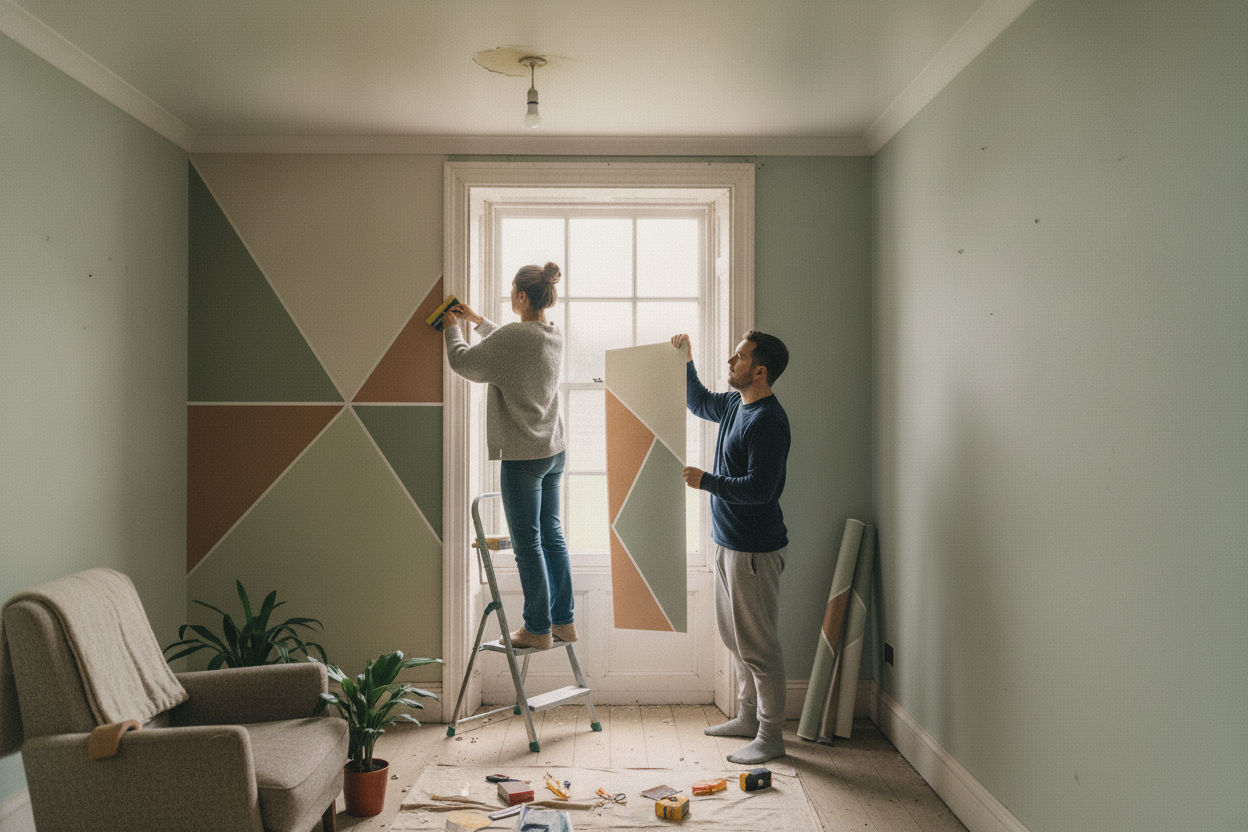
Stand in the doorway and notice where you look first. That wall is almost always the one worth treating, and getting that right is why some feature walls look considered while others look like a tin of leftover paint found a home. Treating one wall properly gives a room depth, texture and personality for a fraction of the cost and mess of full redecoration, which is why a stress-free home renovation usually means working with what you already have.
Key Takeaways
- Treat the wall your eye lands on first from the doorway.
- Test paint with a large sample on lining paper before committing.
- Panelling and slats add depth without changing the colour scheme.
- Paper one focal wall, and order all rolls from the same batch.
- Leave polished plaster to a specialist.
- Echo the colour or material elsewhere in the room.
Bold Colour Is the Cheapest Test, Not the Only Answer
Colour is the lowest-risk way to find out whether a room can take drama at all. Just don’t choose the shade from a 50mm card under a shop light. Paint a large sample, at least A2, on lining paper rather than the wall, and move it around for two or three days, looking at it in the morning, under lamplight and on a grey afternoon.
North-facing rooms pull everything cooler and greyer, so a soft green can turn sickly on one wall and look perfect opposite. One useful rule: deep colours read better on the wall furthest from the window, where shadow gives them weight. A dark wall facing the light often just looks flat.
Panelling, Slats and Shadow Lines
Panelling adds relief rather than colour: the wall shifts through the day as the light moves across it, leaving the scheme untouched. Traditional MDF battens are fixed onto the existing plaster, then caulked, filled and painted. Set the grid out from the centre of the wall, never from a corner, or you will end up with one awkward narrow panel that is all anyone sees. Walls are rarely plumb, so expect to scribe the end pieces.
Fluted and slatted timber panels are quicker and genuinely help with echo in rooms with hard floors, but they suit an unbroken wall behind a bed or sofa far better than one interrupted by doors and radiators. Whatever you fix, check for cables and pipes with a detector first.
Wallpaper Where Pattern Earns Its Place
Wallpaper has quietly become the easiest statement in the house again, partly because paste-the-wall non-woven papers are far more forgiving to hang than the old soak-and-fold types. A single papered wall suits rooms with an obvious focal point already in place, such as a chimney breast or a bed.
Check the pattern repeat before you order and buy all rolls from the same batch number, because dye lots do shift. Large-scale patterns can swallow a small room, but on one wall of a narrow hallway they often do the opposite and stop the space feeling like a corridor.
Natural Materials and Reclaimed Surfaces
Stone cladding, exposed brick and timber all bring something paint cannot, which is variation within a single surface. If your house has a brick chimney breast hiding under plaster, stripping it back can be one of the best statement wall ideas a living room has to offer, and it costs nothing to buy.
Be realistic about the state of what is underneath first. Internal brickwork is often rough, patched with cement, or marked by old flue openings, and once the plaster is off you are committed. Stone-effect slips are the more predictable version of the same look and go on with adhesive and a notched trowel.
Specialist Plaster Finishes for a Tactile Look
Limewash gives a soft, chalky surface with real movement, brushed on in loose cross-hatch strokes. It bonds beautifully to bare plaster; over emulsion it needs a mineral or gritty primer first, a step people skip and then wonder why it patches.
Polished plasters such as marmorino and Venetian plaster go on in thin passes with a steel trowel and are burnished to a sheen, so the result depends on the hand applying them. A specialist usually costs less than doing it twice. evokepolishedplastering.co.uk is one example of a London-based contractor specialising in Venetian, marmorino and stucco finishes, with a portfolio showing the range of textures and sheens possible.
Microcement handles wet areas once primed, meshed and sealed, making it popular behind a bath or in a shower. Ask for a sample board first, as the colour reads differently at full scale.
Keeping the Rest of the Room in Balance
A feature wall fails most often by being left to fend for itself. Echo the new colour or material somewhere else, a lampshade, a cushion or the inside of a bookcase, so it reads as intentional.
Consider what is already competing. A kitchen with patterned tiles, open shelving and a bold splashback does not need a sixth thing. In bedrooms, a simpler treatment tends to win: the wall is there to frame the bed. Existing materials matter too. A warm oak floor fights with cool grey-blues and sits happily with earthy clay tones and limewash, so hold your chosen finish against the floor and woodwork in daylight before ordering.
Most statement walls that go wrong were decided in a shop. Most that go right were decided standing in the room, at different times of day, with a large sample taped to the plaster.
Frequently Asked Questions
Can You Create a Statement Wall in a Rented Home?
Peel-and-stick wallpaper and freestanding slatted panels are the most renter-friendly options, as both can be removed without damaging the plaster. Always check your tenancy agreement before making any changes, even temporary ones.
Does a Statement Wall Add or Reduce Resale Value?
A well-executed neutral-toned panelled or plastered wall is unlikely to put buyers off and can make a room photograph better for listings. A very bold or personalised finish carries more risk, since buyers may factor in the cost of reversing it.
How Do You Handle a Statement Wall With Alcoves or a Chimney Breast?
Treat the chimney breast as the focal point and carry the finish into the alcoves at a reduced depth or in the same colour, so the whole wall reads as one considered surface rather than three separate areas. Avoid using different materials in each recess, as it tends to look busy rather than intentional.

